Deep-dive: X-Pac
Introduction
You often hear that X-Pac comes from sailcloth. But what exactly is it? How did sailcloth end up on bags? What do cryptic ciphers like VX21 and X42 stand for? And what about the fearsome “delamination”? Let’s dive in and find out.
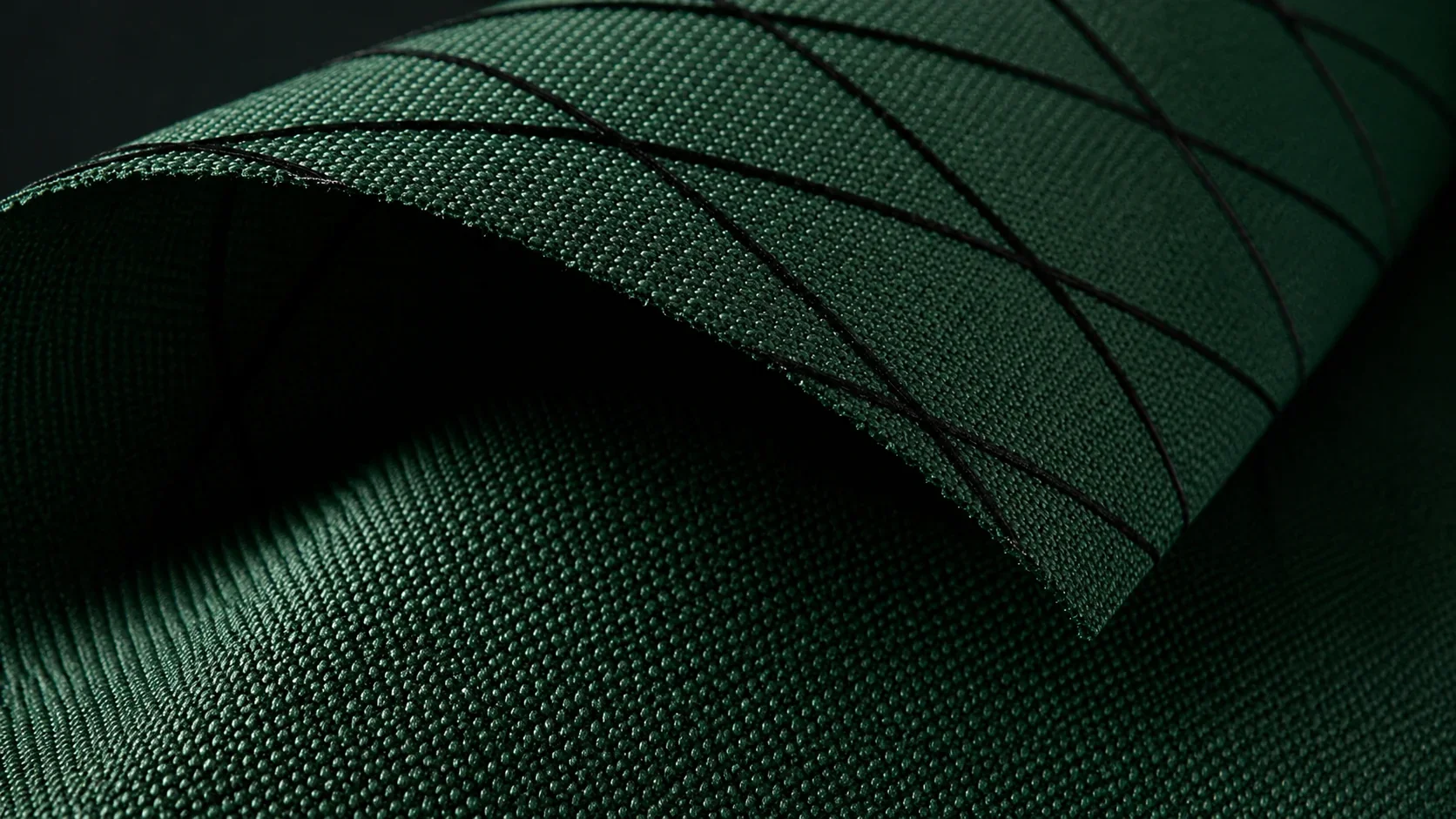
Closeup on X-Pac (generated image for illustration purposes)
What is a laminate?
A laminate is two or more layers bonded together. Each layer can be a different material with its own properties, so by combining ones that offset each other's weaknesses, you get something more than the sum of its parts.
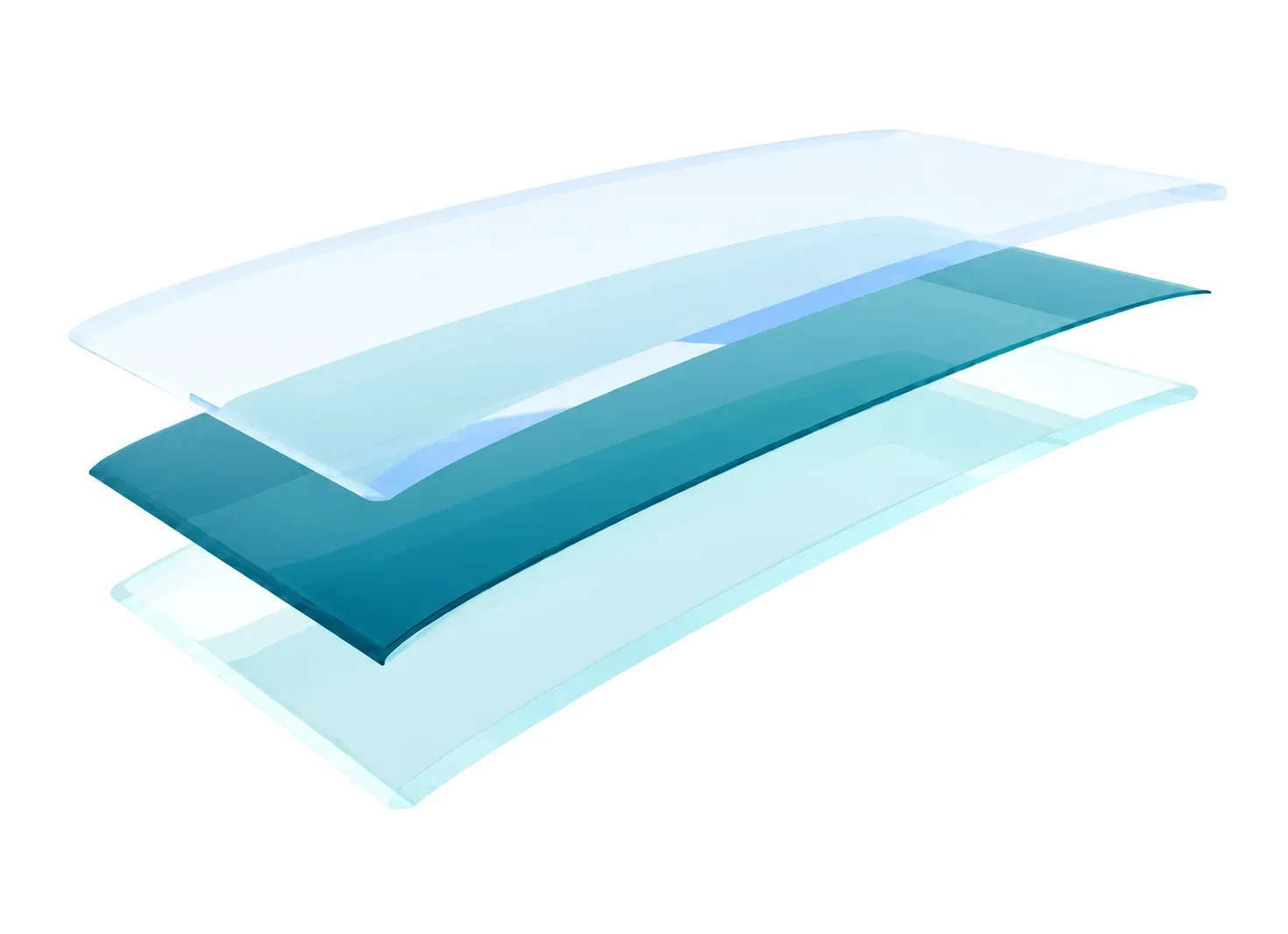
Simplified visualization of a car windshield structure (generated image for illustration purposes)
Think of a car windshield. It's two layers of glass with a thin plastic sheet sandwiched between them. The glass gives you structure and clarity. The plastic holds everything together if the glass shatters—which is why a cracked windshield stays in place instead of spraying into the car.

X-Pac is a laminate. So what's actually in it?
Polyester
If you thought, “Wait, aren’t we talking about X-Pac?”, bear with me for a moment. We explored nylon in detail previously, but to better understand X-Pac, we need to touch on polyester as well.
Polyester, like nylon, is a synthetic polymer made from oil. The chains are linked together with a different type of bond, called an ester bond, instead of nylon’s amide bond. The chemistry is different, but the basic idea is the same: long-chain molecules are melted, pushed through tiny holes to form fibers, and woven into fabric.
The version of polyester used in bags is called PET—polyethylene terephthalate (yeah, don’t try to pronounce that). You have heard the term “PET bottles,” right? It is the same plastic, just spun into fibers.
So what’s the difference between polyester and nylon?
Polyester absorbs almost no water. Nylon soaks up to 10% of its weight in moisture; polyester is closer to 0.4%. Wet polyester stays the same weight and dries faster.
Polyester attracts more lint. Its strong resistance to absorbing water comes with poor electrical conductivity, which means polyester builds up static and attracts lint.
Polyester doesn't stretch under load. Nylon stretches a bit when pulled, then springs back. Polyester is dimensionally stable—once it is woven into a shape, it stays in that shape.
Polyester resists UV better. Sunlight degrades nylon faster than polyester. A polyester bag left in the sun for years will hold up better than a nylon one.
Polyester is denser. 1.38 grams per cubic centimeter versus nylon’s 1.14. That means a polyester fabric of the same denier as a nylon fabric is thinner. Remember that denier is mass per length. If two yarns weigh the same per length but one is made of denser material, the denser material packs more mass into less volume. Less volume means a thinner yarn.
Polyester is less abrasion-resistant and less tear-resistant. For a bag that is going to be dragged across surfaces and snagged on things, nylon is the better choice. For something that needs to hold its shape and not absorb water—you know, like a sail—polyester wins.
Now all the building blocks are in place, and we can finally get into X-Pac proper.
What is X-Pac?
There is a sailcloth manufacturer called Dimension-Polyant, founded in 1966, with operations in Germany and the US. In the mid-2000s, they noticed that the same properties that make good sailcloth—waterproof, dimensionally stable, lightweight—would also make great bag fabric, and launched X-Pac, a purpose-built laminate designed specifically for bags.
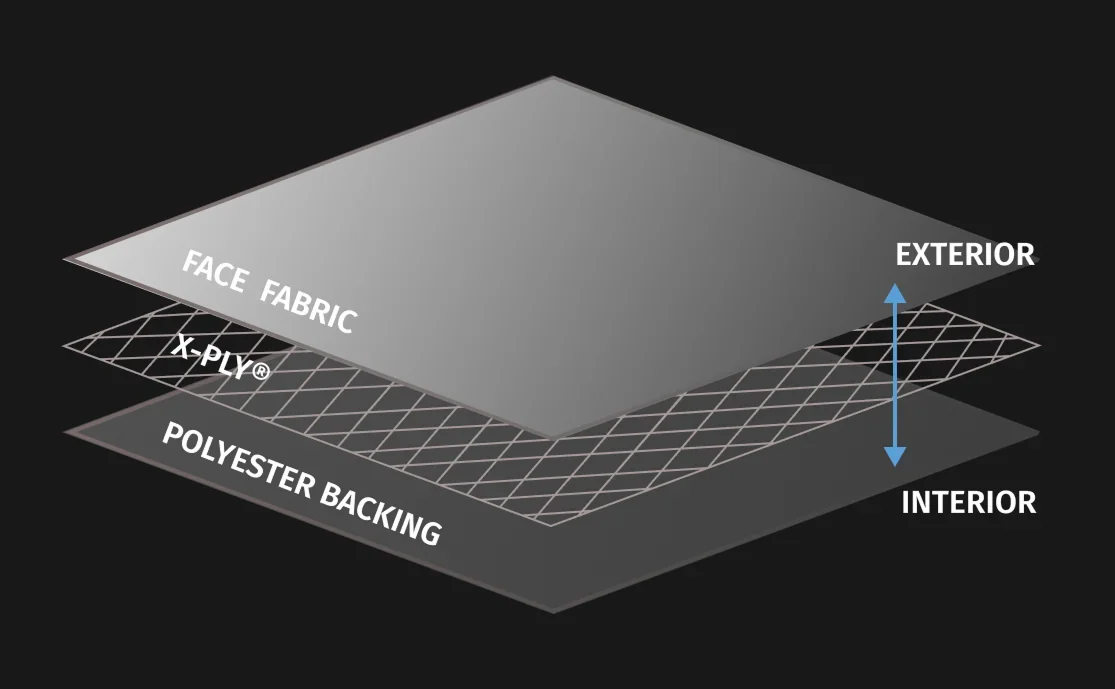
Schema of X-Pac X3 structure (image from X-Pac official website)
X-Pac comes in two variants: 3-layer (X3) and 4-layer (X4) laminates. The common layers are:
Face fabric (usually nylon, sometimes polyester). Provides abrasion and tear resistance and is what you see and touch on the outside of the bag.
X-PLY reinforcing fibers. Those signature X-shapes that create the distinct diamond pattern. They provide dimensional stability, reduce stretch, and distribute load evenly across the fabric.
Polyester film (not fabric—actual film, like the material a plastic water bottle is made from). This is where the waterproof property comes from.
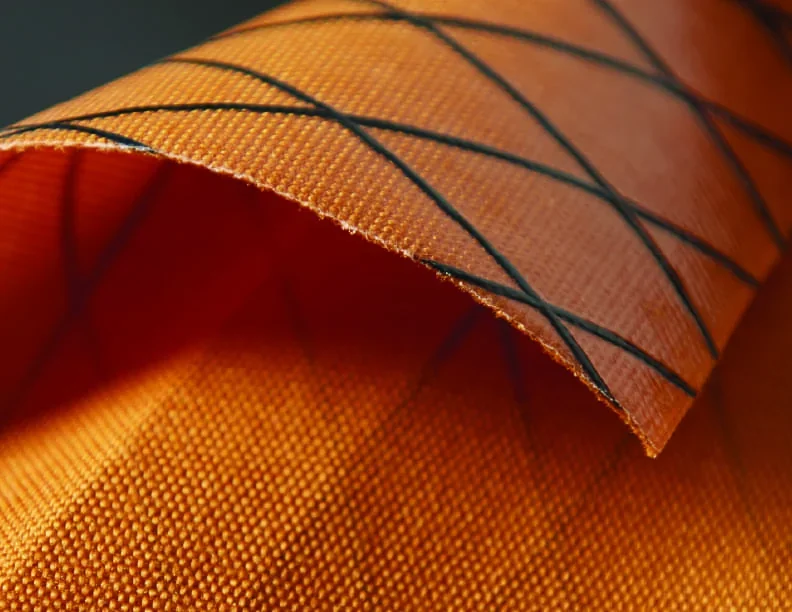
Sample of X-Pac X3 (image from X-Pac official website)
X4 adds a fourth layer: a thin polyester fabric backer on the inside. This protects the waterproof film from being scratched up by items inside the bag and gives the interior of the fabric something actually nice to the touch instead of slippery, plastic-bag-like bare film.
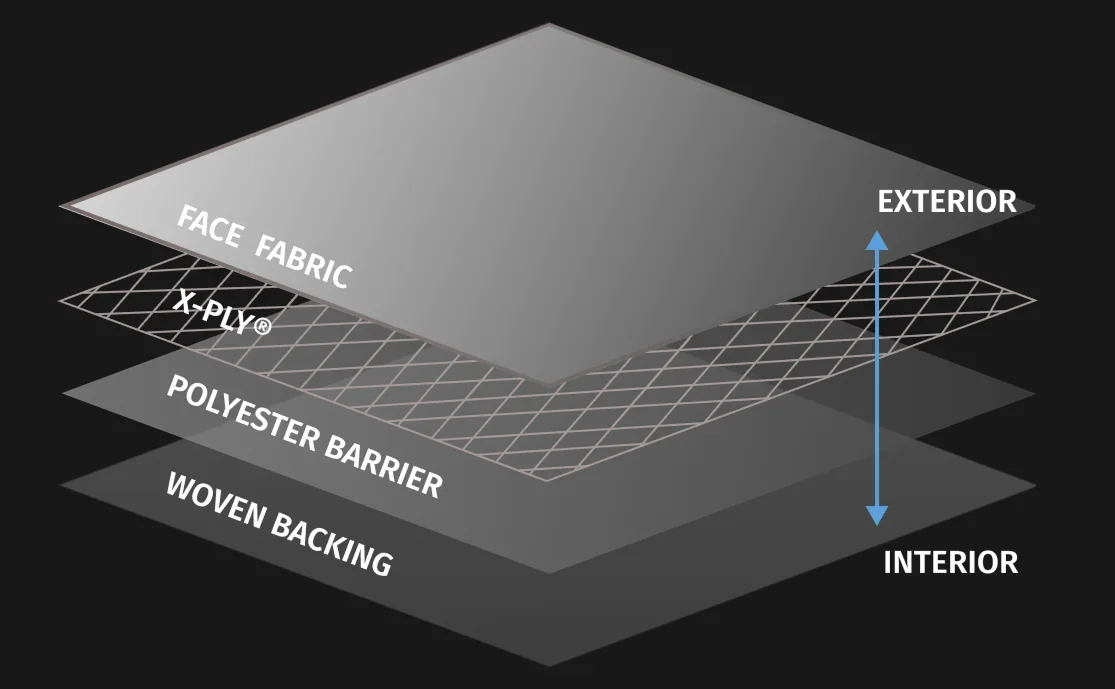
Schema of X-Pac X4 structure (image from X-Pac official website)
In practice, though, most bags have an additional nylon or polyester inner lining, so the choice of material usually comes down to weight, abrasion and tear resistance, and available colors.
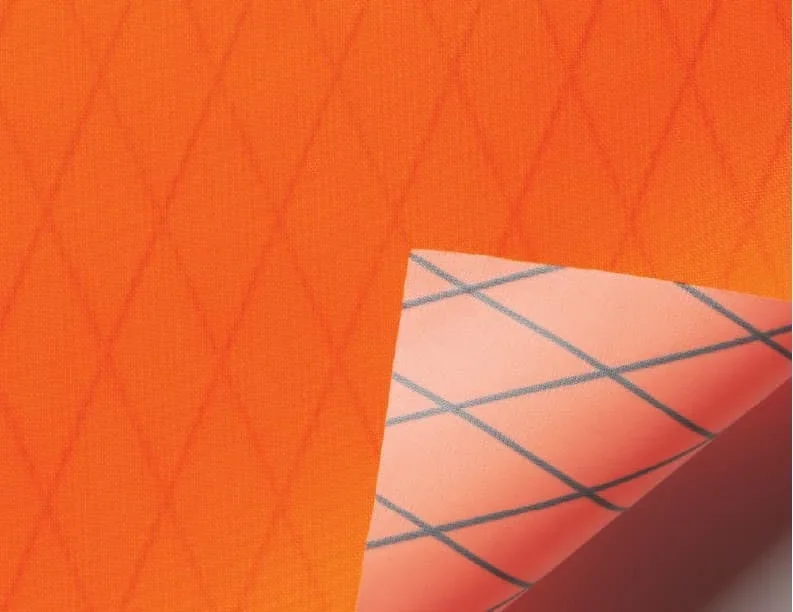
Sample of X-Pac X4 (image from X-Pac official website)
With the basics covered, let's get into the technical weeds. Be warned, X-Pac naming convention is a bit of a mess.
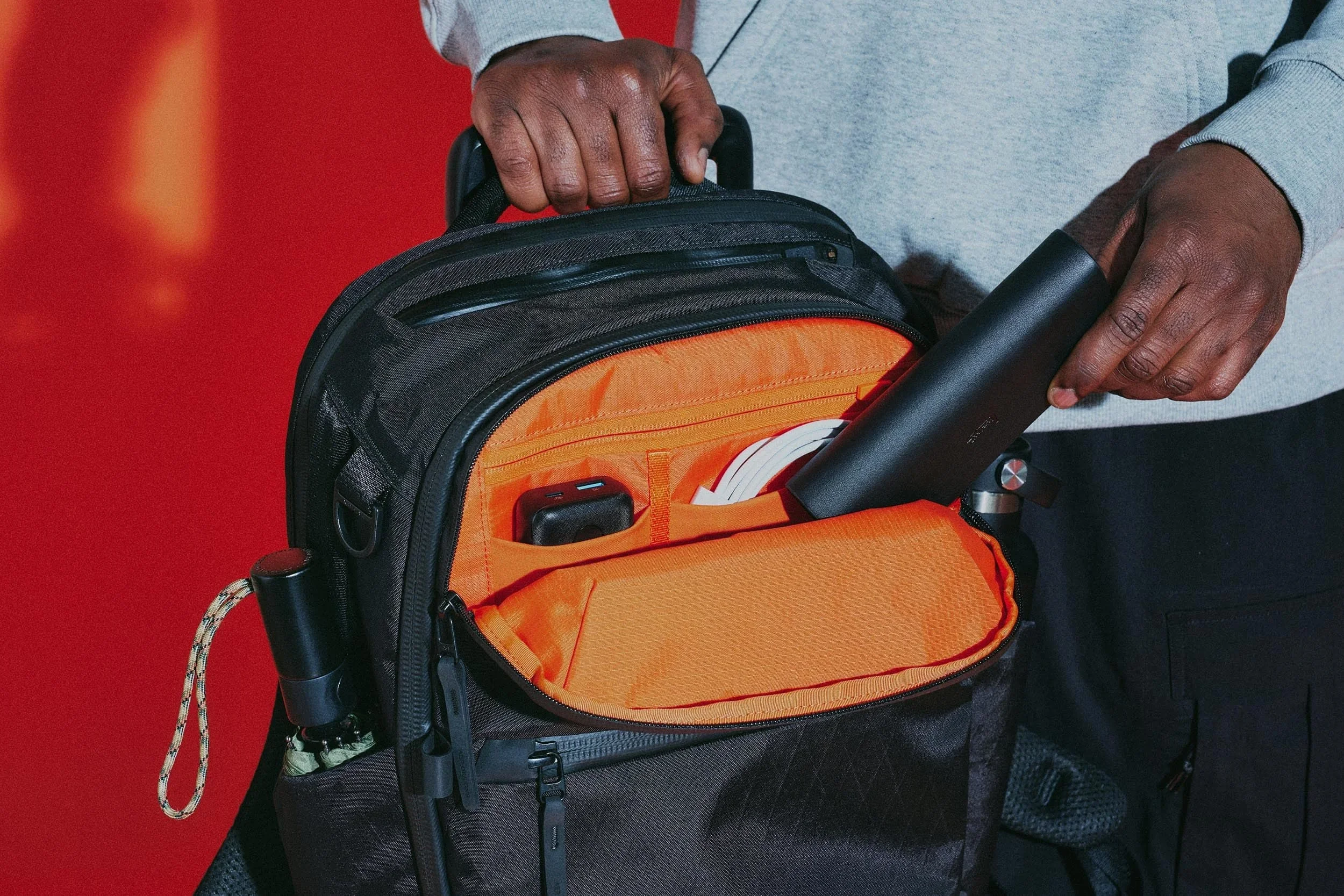
Aer City Pack Pro 2: VX42 X-Pac exterior and orange ripstop nylon interior lining (image from Aer website)
X-Pac Specs
If you go to the X-Pac website and search for details about fabric options, you’ll see cryptic stuff like “Tear Strength: Warp 139.7 N / 31.4 LBS, Fill 105.4 N / 23.7 LBS”, “Abrasion ASTM 3884: 1700 cycles”, and “Waterproof: 13.8+ bar / 200+ psi”. It’s time to unpack these.
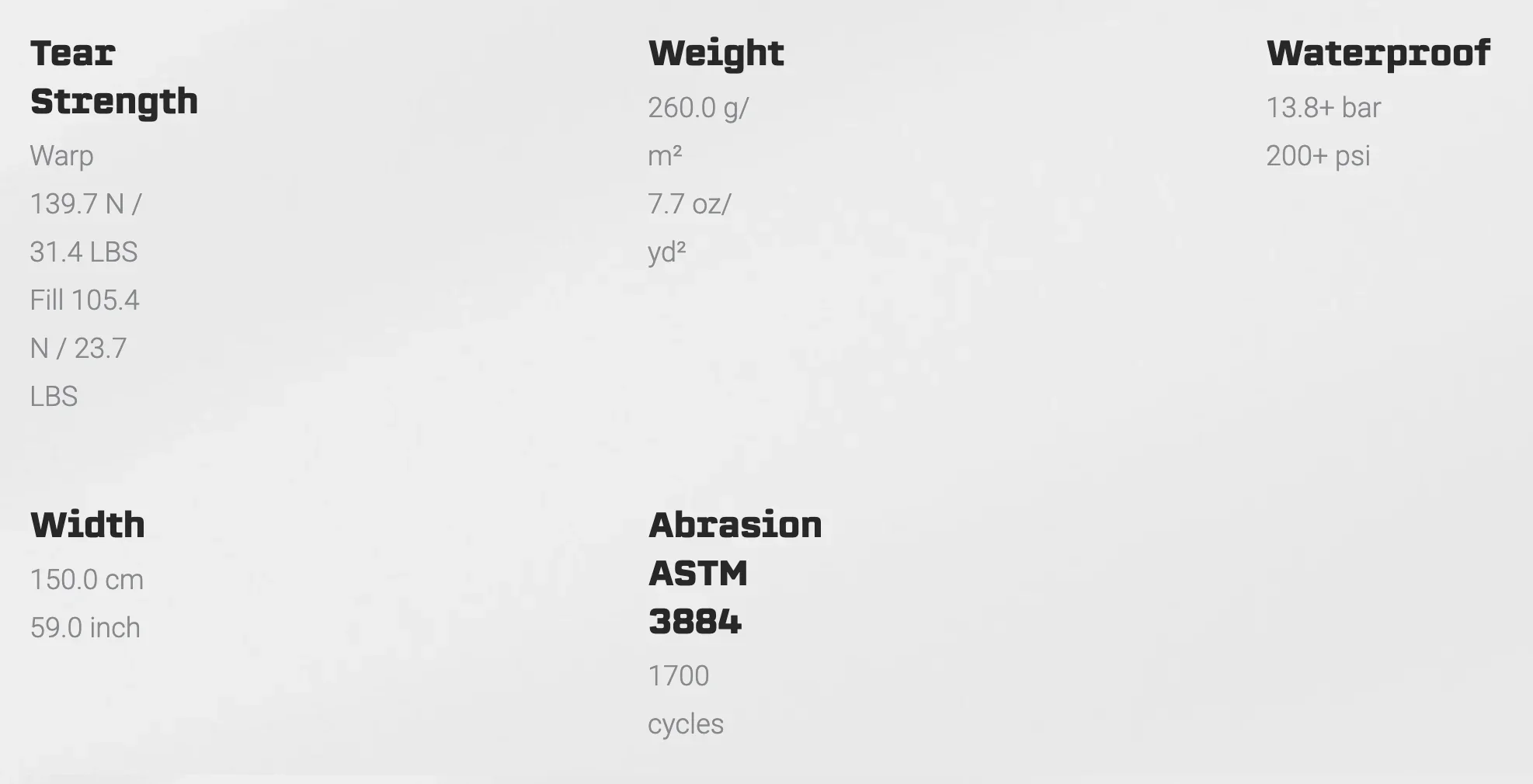
Specs for X-Pac X42 (screenshot from X-Pac official website)
Tear Strength
Tear strength measures how much force it takes to propagate an existing tear through the fabric. Note “propagate”—this isn't how hard it is to start a tear; it's how hard it is to keep one going once it's started.
The test: a small slit is cut into the fabric, then the fabric is pulled in a way that drives the tear through the material. The force required to keep the tear moving is the tear strength. The standard test for fabrics is ASTM D2261 (tongue tear) or ASTM D1424 (Elmendorf tear), and results are reported in newtons (N) or pounds (LBS).
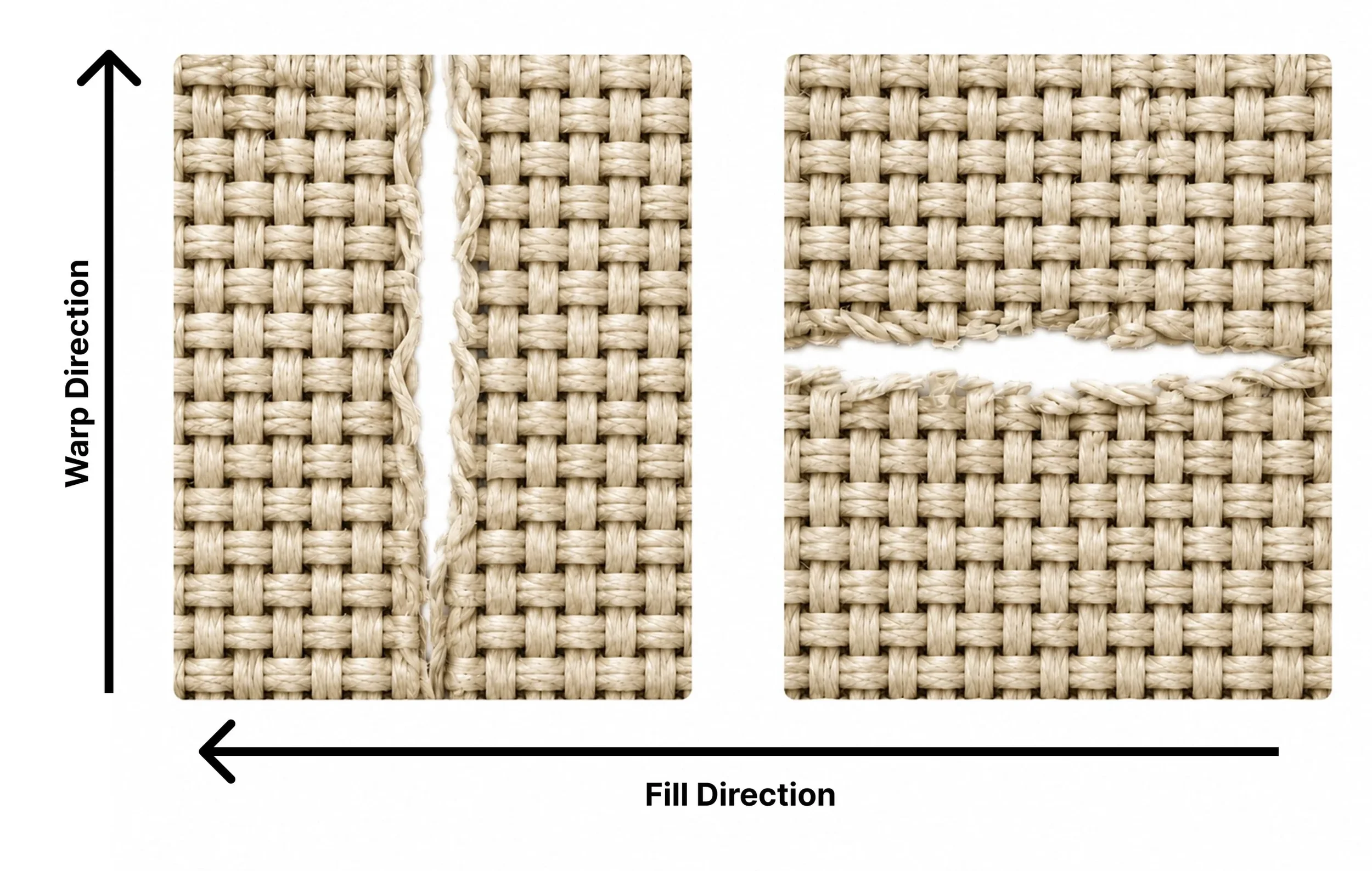
Tear: warp vs. fill direction (generated image for illustration purposes)
Warp is the direction parallel to the long axis of the fabric roll (lengthwise). Fill (also called weft) is perpendicular to that (crosswise). Tear strength is almost always different in the two directions because the yarn count, yarn type, and weave structure can differ between warp and fill. For X-Pac specifically, the X-PLY scrim adds reinforcement on diagonals, which affects both directions but not equally.
So this fabric—which is X42—needs 140 N (about 14 kg of force) to propagate a tear lengthwise and 105 N (about 10.5 kg) to propagate a tear crosswise. The warp is stronger, which is typical.
Abrasion
ASTM D3884 is the Taber abrasion test. The fabric sample is mounted on a rotating turntable, and two abrasive wheels are pressed against the surface as it rotates. Each rotation is one “cycle.” The test runs until the fabric fails—typically defined as a hole appearing, the fabric breaking through, or some other defined endpoint.
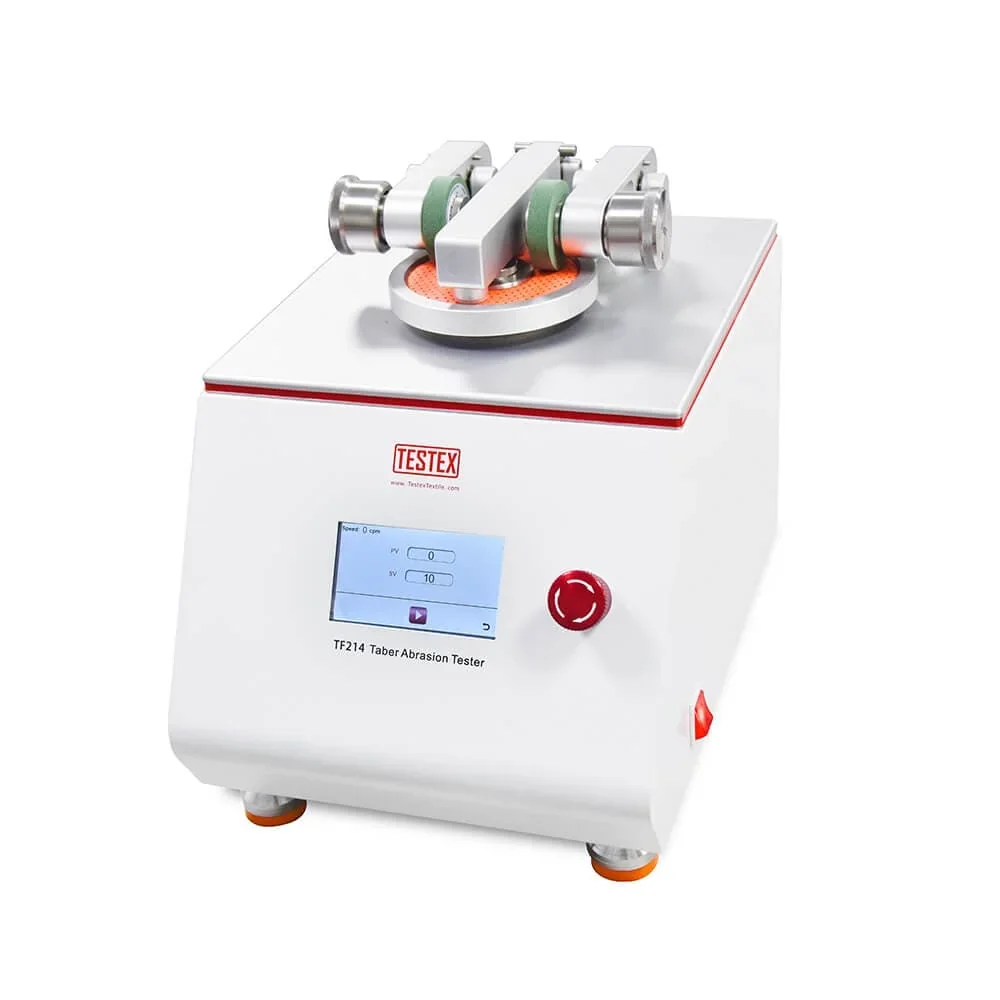
Taber Abrasion Tester Machine
So 1,700 cycles means the fabric survived 1,700 rotations under the abrasive wheels before failing the test criteria.
"Waterproofness"
This is hydrostatic head or water column pressure—how much water pressure the fabric can hold before water penetrates through. The test (ISO 811 or AATCC 127) involves clamping the fabric and gradually increasing water pressure on one side until water visibly pushes through.
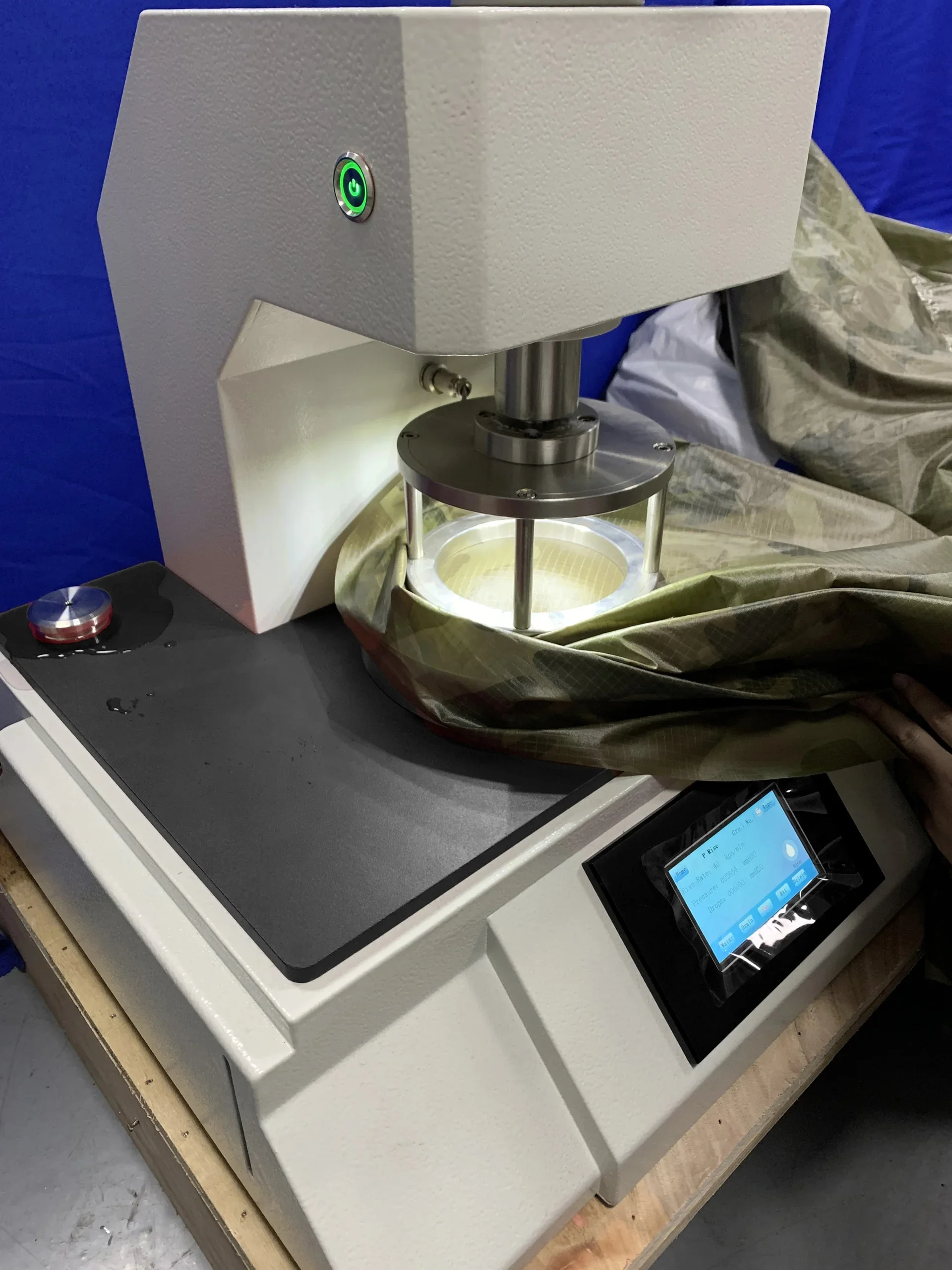
ISO 811 Test Machine
X-Pac Variants
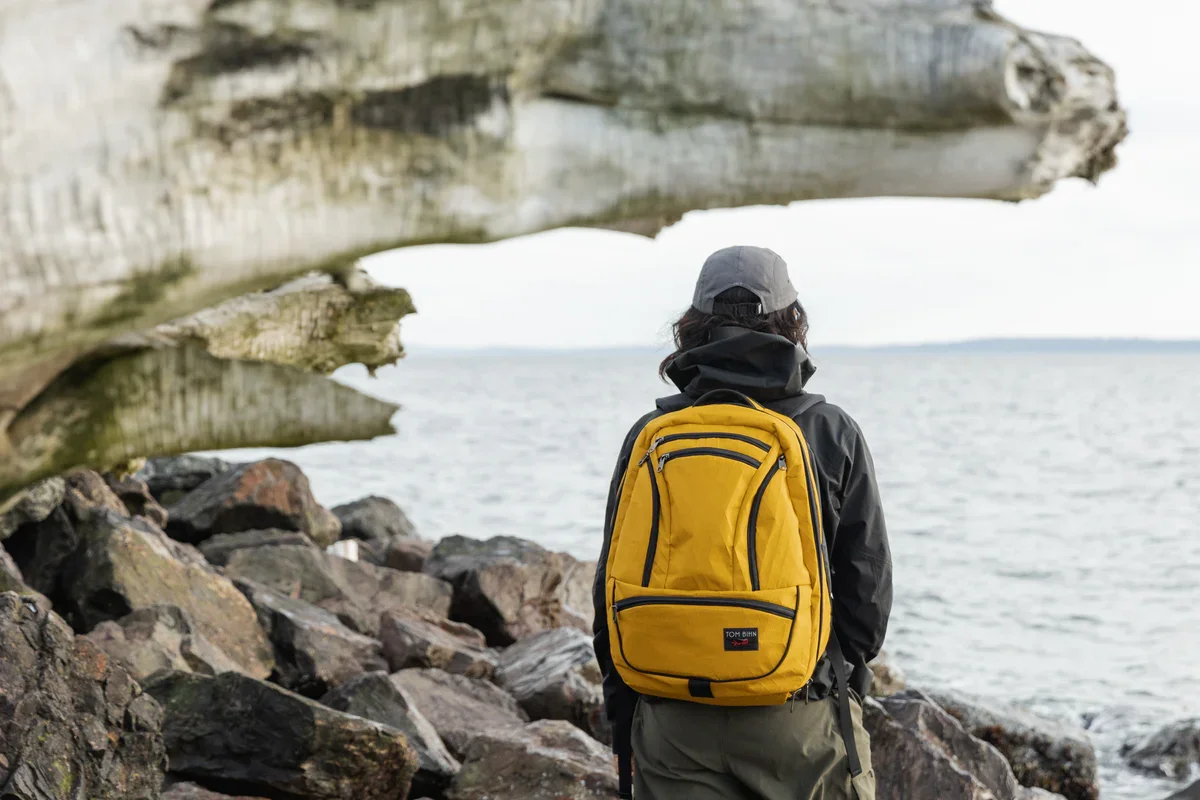
Tom Bihn Synik 30 in X-Pac RX-30 (image from Tom Bihn website)
Within Dimension-Polyant's own lineup, numbers are directly comparable since they all come from the same testing setup. Comparisons across different fabric brands (Cordura vs. X-Pac, etc.) are trickier because test conditions vary.
All variants are waterproof, which isn't a surprise considering that's the main feature and they all use the same polyester film. What's more interesting is weight, tear- and abrasion-resistance.
Even though RX30 has a thicker face (300D polyester) and weighs more, the lighter X21 (210D nylon) matches it in tear strength. Polyester really is less tear-resistant than nylon at comparable denier.
The extra layer in X4 fabrics (VX21, VX42) adds significant tear resistance—45–70% more—for only 15–20% more weight compared to X3 versions with the same nylon face denier (X21, X42).
RX30 actually scores higher on the Taber abrasion test (2,000 cycles) than X42 (1,700 cycles), despite the conventional wisdom that nylon should rain superior here. Possible reasons include the thicker 0.5 mil film (vs 0.25 mil in other variants) and the specific recycled polyester yarn used.

Able Carry Max EDC in X-Pac VX21 (image from Able Carry website)
Also, looking closely at the spec sheet helps us decode the naming convention: V means it has a backer (X4 construction), the X is for the X-PLY scrim, and 42 indicates a 420D face fabric.
All X-Pac variants share the same weakness, though: delamination. We'll get to that next.
Delamination
Remember that X-Pac is a laminate, with layers bonded together by adhesive. When that adhesive fails and layers separate, you get delamination. Visually, it shows as bubbling, wrinkling, or the face fabric lifting away from the underlying scrim and film.
There’s no guarantee you’ll experience delamination. The general consensus is that it’s rare but not uncommon, although I couldn’t find any concrete examples, so don’t let that turn you away from X-Pac right away.
A few practical tips to minimize chances of delamination: don't machine wash and dry your X-Pac bag, don't leave it in a hot car for days at a time, and don't store it wet for extended periods. Beyond that, just use it.
With that out of the way, let’s try to answer the question.
When to consider X-Pac
Consider X-Pac if you value structure and weatherproofing. X-Pac bags hold their shape, are highly water-resistant (the fabric itself is waterproof, but there are still seams and zippers), and look distinctively technical. They're a noticeable step up from nylon-based fabrics in everything except abrasion resistance, where high-denier (over 500D) Cordura nylon still holds the edge.
Conclusion
Thank you for reading till the end. Leave comments below, and feel free to point out where I was wrong and share your experience with X-Pac bags. Next up: Ultra. Stay tuned.