Deep-dive: Nylon
Introduction
I’ve decided to start a new series different from my usual gear reviews. Join me on a journey of discovering what our favorite bags are made out of, starting with fabrics. Strap in, we are going down to the molecular level.
Top to bottom: 1680 Cordura Ballistic Nylon, 1000D Cordura Nylon, 210D Cordura Ripstop Nylon (generated image for illustrative puposes)
What is a polymer?
A polymer is a really long molecule, and a molecule is a collection of atoms. Most molecules are small. Water is three atoms, and sugar is a couple dozen. A polymer is hundreds or thousands of atoms strung together in a chain. That’s the basic concept.
There are multiple ways to link molecules into chains. The one that is interesting to us is a polyamide.
What is a polyamide?
A polyamide is a polymer in which molecules are connected by an amide bond. This bond is strong and stable. It does not come undone easily and also allows neighboring chains to grip tightly to each other. Basically, very sticky spaghetti.
Silk and wool are examples of natural polyamides. Nylon uses the same principle, but it is produced in a factory.
So what is nylon?
The raw material for nylon is oil. First, oil is broken down into small molecules that become the beads of chains. Then those beads are polymerized into chains. At that stage, nylon looks like small pellets.
Nylon Pellets (generated image for illustrative purposes)
Now, before we go further, you should know that there are two widely used types of nylon: Nylon 6 and Nylon 6-6. The one that is almost exclusively used in bags is Nylon 6-6. It absorbs less moisture, has better wear resistance, and has a higher melting point of 265°C. Why does that matter? Because to make fiber, nylon is melted.
After it’s melted, it gets pushed through a large metal plate with thousands of holes and cooled down to form fiber. It’s similar to how spiders make their web, actually.
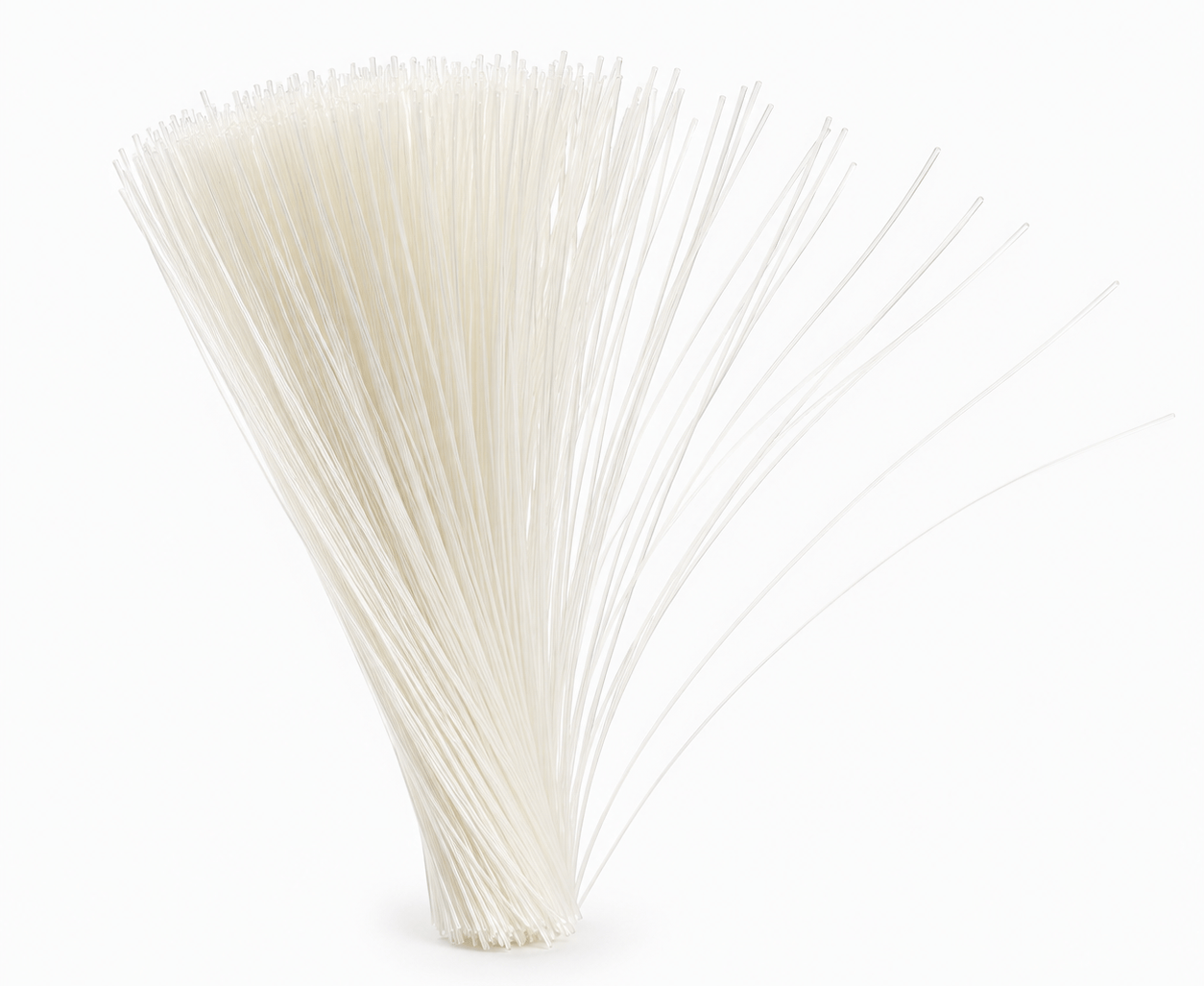
Nylon Fibers (generated image for illustrative purposes)
The resulting fibers are twisted together to form a yarn, yarns are woven together into a fabric. That fabric is what we usually mean when we say “nylon”.
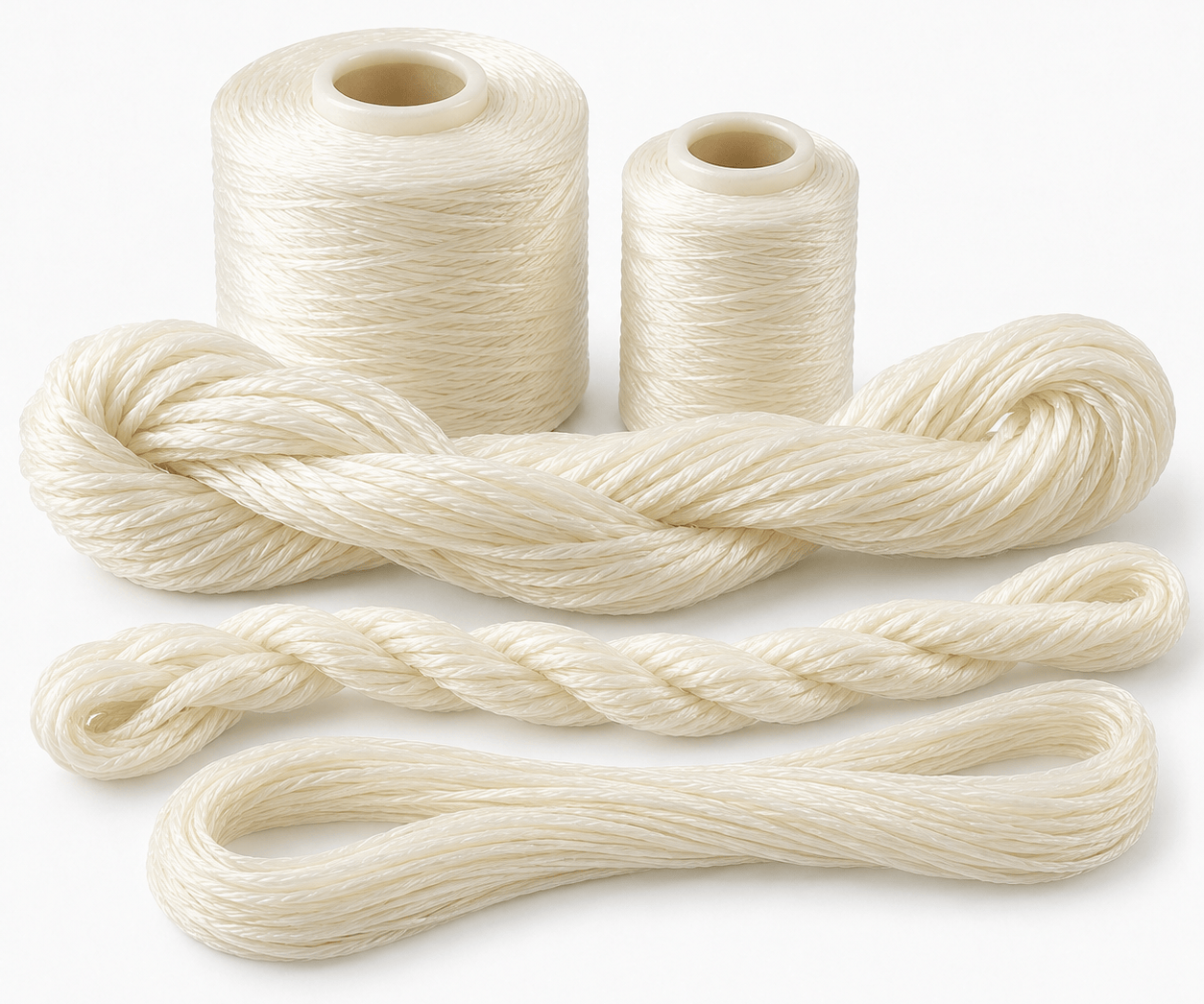
Nylon Threads (generated image for illustrative purposes)
Weaves
There are many ways to put yarns together, those ways come in distinct patterns and are called weaves. Three weaves that matter in the context of bags: plain, basket and ripstop.
Plain weave
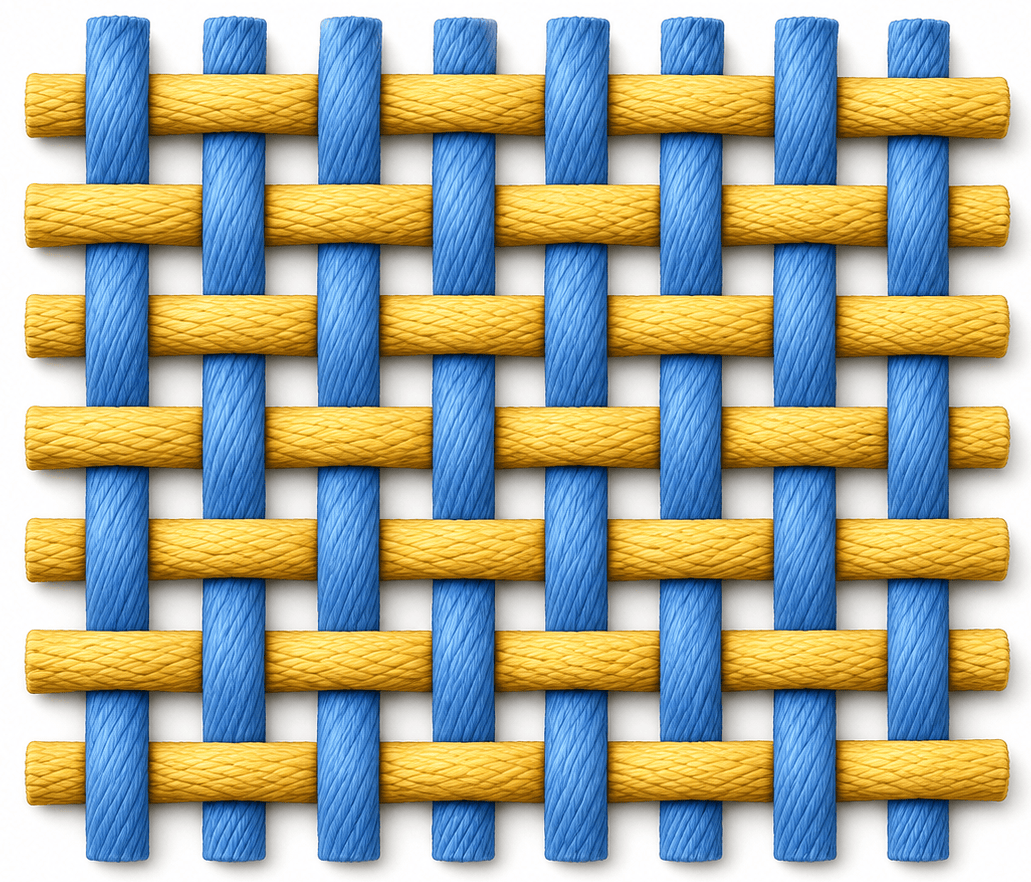
Plain Weave (generated image for illustrative purposes)
The simplest possible pattern. One yarn over the other, under the next, over the next and so on. A lot lightweight nylons are plain weave.
1000D Cordura Nylon (image from Able Carry’s website, AI upscaled)
Basket weave
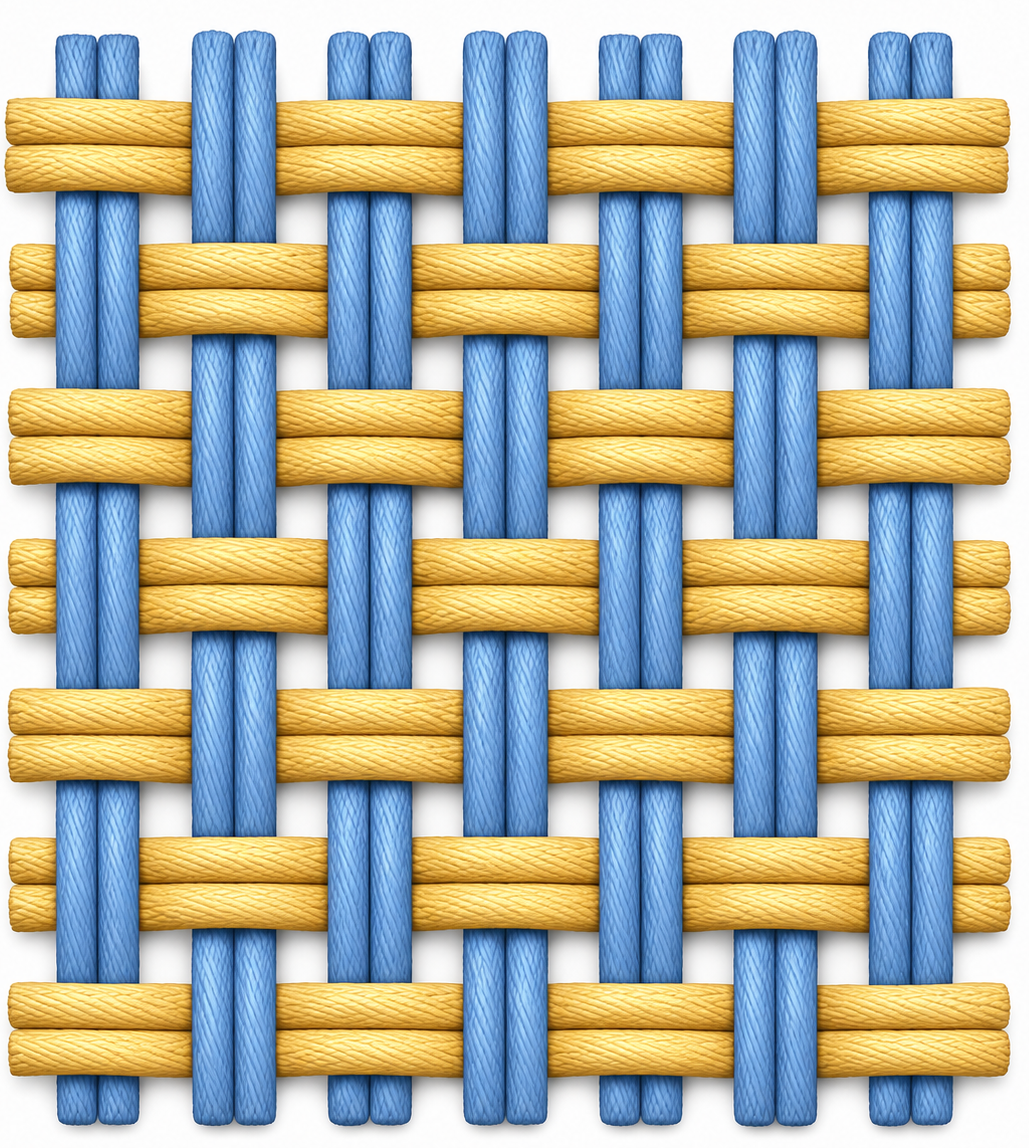
Basket Weave (generated image for illustrative purposes)
A variation on plain weave where instead of going one-over-one, you go two-over-two, or three-over-three yarns at a time. Up close, this type of weave looks like a checkerboard.
The advantage of such weave is abrasion resistance. When something rubs against the fabric (image dragging your, eh, maybe someone else’s bag on the ground), it’s rubbing across multiple yarns at once, the loads spreads out, the fabric resists better. This is why ballistic nylon uses a basket weave. Originally developed during World War II as a flak jacket material (hence the name "ballistic"), it turned out to be too weak to stop bullets but excellent for military backpacks.
There is a tradeoff, though, the basket weave is less tear resistant, if a tear starts, it runs along multiple yarns grouped together instead of just one. To offset that weakness, ballistic nylon usually comes in higher denier, like 1050D or 1680D (we’ll talk about denier—the “D”—later, for now think: the higher the denier, the thicker the fabric).
1680D Cordura Ballistic Nylon (image from Able Carry’s website, AI upscaled)
Ripstop weave
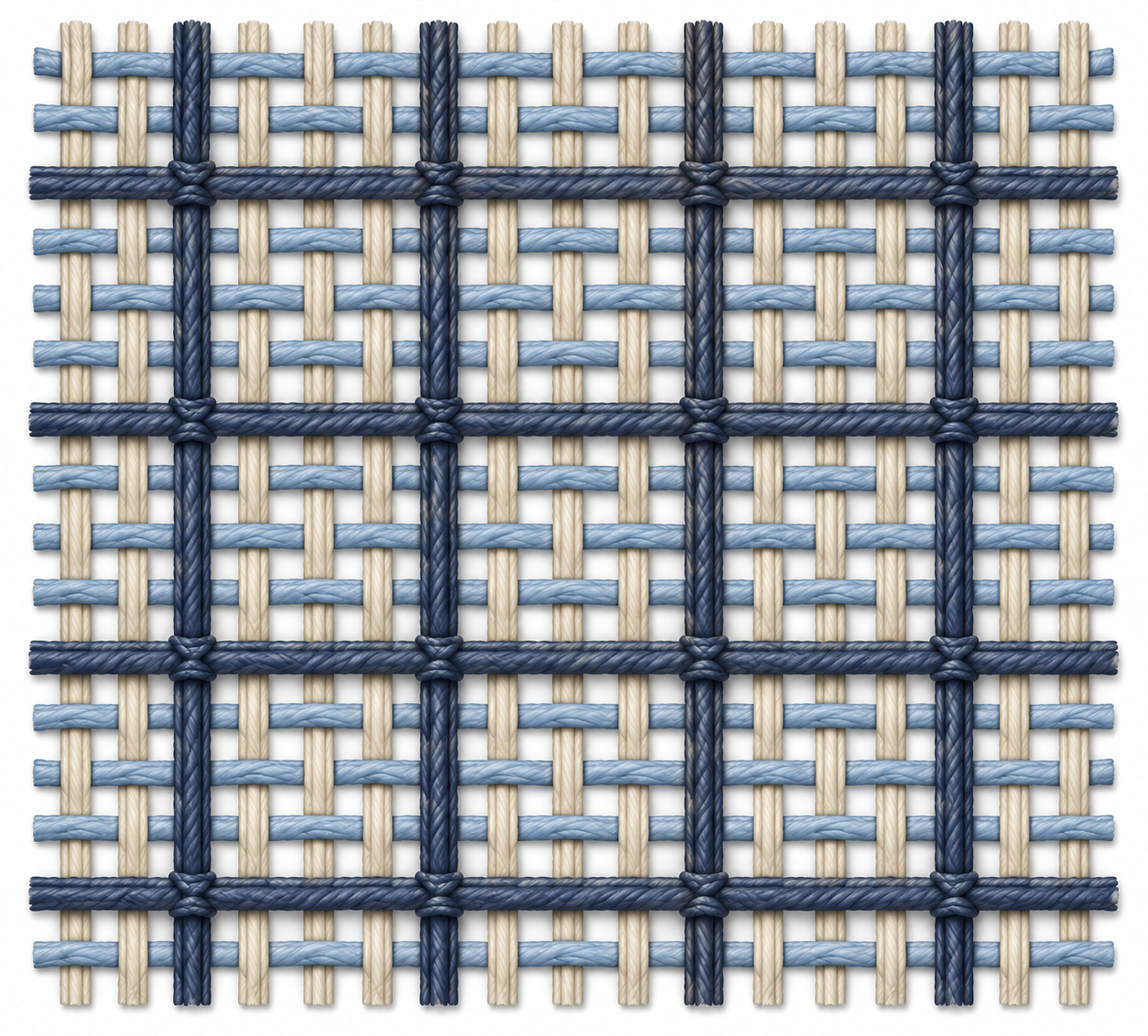
Ripstop Weave (generated image for illustrative purposes)
It’s a plain weave with reinforcement yarns woven in at regular intervals, usually every 5 to 8 millimeters. These reinforcement yarns are thicker than the base yarns, and they create the signature grid pattern.
The name tells you exactly what it does. When the fabric tears, the tear runs through the lightweight base yarns easily, but then it hits a reinforcement yarn and stops. The thicker yarn doesn't break, and the damage stays contained in a small grid square instead of running across the whole fabric.
Ripstop was developed for parachutes during World War II for exactly this reason. A small puncture in a parachute could otherwise tear into a catastrophic split mid-jump.
210D Cordura Ripstop Nylon (image from Able Carry’s website, AI upscaled)
Denier
This is what “D” stands for in 500D or 210D, it’s a measure of mass per unit length of a yarn, or specifically grams per 9000 meters. Why 9000 meters? You are going to have to go to medieval France to find out. Anyway, so 500 grams per 9 kilometers is a 500D, 1000 grams per 9 kilometers is a 1000D.
Now, different materials have different densities. Nylon is 1.14 grams per cubic centimeter, polyester is 1.38 grams, Ultra — 0.97 grams. That means that the denier does not translate into thickness across fabrics but is a good mental model for denier of the same fabric.
Weight
Let's work out how heavy a square meter of fabric actually is. Take 500D nylon in a plain weave with 12 yarns per centimeter running one way and 12 yarns running the other. 500D means 9000 meters of yarn weigh 500 grams, so 1 meter of yarn weighs 0.056 grams.
In a 1 square meter of fabric, you've got 12 yarns per centimeter multiplied by a 100 centimeters, that’s 1200 yarns running in one direction, each 1 meter long. That's 1200 meters of yarn. Same in the other direction: another 1200 meters. Total: 2400 meters of yarn packed into one square meter of fabric. 2400 meters × 0.056 grams per meter works out to about 134 grams per square meter.
Real 500D Cordura nylon is about 220–250 grams per square meter, so where all the extra weight comes from?
First, yarns don't lie flat in a weave. They wave up and down as they cross over and under each other. So a 1 meter length of fabric actually contains about 10% more in a typical plain weave. That bumps our 134 grams up to around 147 grams.
Second, the back of the fabric is coated. Almost all bag nylons have a layer of polyurethane (PU) painted onto the back side. The PU coating seals the weave, makes the fabric water-resistant, and adds some structure. It also adds weight — typically 30 to 50 grams per square meter, depending on how thick the coating is. That's a huge chunk on top of a 134 gram base.
The face side of the fabric usually gets a treatment too, called DWR — Durable Water Repellent. It's a chemical finish that makes water bead up and roll off instead of soaking in. DWR is light, basically negligible weight-wise, but it's the reason a new bag sheds rain so well.
So the full picture of a typical premium 500D bag fabric: high-tenacity Nylon 6,6 yarn, plain weave at roughly 12-14 yarns per centimeter in each direction, PU coating on the back for water resistance and structure, DWR on the face for water beading. About 230 grams per square meter all in. That’s the real weight of the fabric used in bags.
Brands
You see “Cordura” a lot, including in the examples above, but what is it? Cordura isn’t a fabric. It’s a brand that makes fabrics, typically nylon-based, though there is some polyester as well. It was established in 1967 and has become the default source of fabrics for premium bag brands like Aer, Able Carry, and GORUCK. But Cordura is not the only one.
Creora Robic, or just Robic, is a line of nylon fabrics from the Korean manufacturer Hyosung, which has also been around since the 1960s. It’s less popular among boutique brands, but you can find it on Osprey or ULA packs.
Conclusion
If you’ve made it this far, you deserve the Bag Nerd achievement. Let me know in the comments what you think about posts like this, where I was wrong (I almost certainly was wrong somewhere), and stay tuned for similar deep dives into X-Pac and Ultra.